Act I: The Trouble With Books About Replatforms
The Messy Middle
Month four. Conference room. The Gantt chart on the projector looks, frankly, beautiful: a smooth gradient of teal bars marching left to right, dependencies satisfied, swim lanes neat as a swimsuit catalog. The slide is titled Migration Plan—Updated. The slide was last updated in week six.
Eleven people are looking at the slide. Nobody is looking at each other.
The project manager has highlighted the plan in three colors. There’s a fourth color she stopped using, because the fourth color started lying to her. The Head of E-Commerce has not spoken in twenty-two minutes. The lead engineer is doing something on his laptop that is either taking notes or refreshing his email, and the difference, at this point, doesn’t really matter. Somebody’s coffee has gone cold next to a printed copy of the deck that the agency presented in week three—the one with the architecture diagram that doesn’t include the order management system, because in week three nobody told the agency about the order management system. The standup ran 47 minutes this morning. Tomorrow’s will run longer.
This is month four. This is what month four looks like. And if you’ve been here, even once, you already know that the meeting will end the way it always ends, which is with somebody saying let’s circle back on this next week and somebody else nodding in a way that means we will not, in fact, circle back on this next week.
Welcome to the messy middle.
You did your homework. You read the Shopify docs. You read the agency’s pitch deck. You read three articles that all cited the same Gartner report. You hired the consultant. The consultant gave you a stage-gate diagram with crisp little hexagons in it and the crisp little hexagons had names like Discovery and Architecture and UAT. You were, by any reasonable measure, prepared.
And then the project started, and at some point—you’d be hard pressed to say exactly when—you crossed a line you didn’t see on any of the diagrams. The hexagons stopped applying. The Gartner report stopped applying. The agency’s reference architecture, the one with the clean little boxes and the clean little arrows, started looking less like a map and more like a brochure for a place that doesn’t exist.
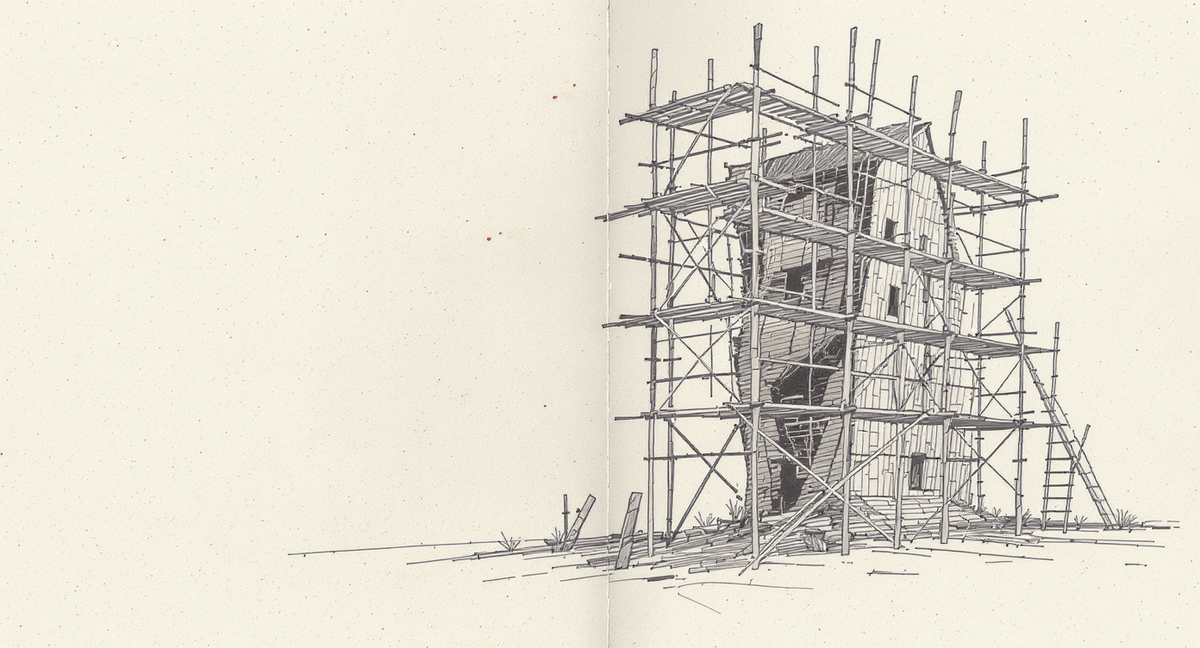
This is the line between what you can google and what you can only live through. It is the territory the official documentation declines to enter. It is, in a sense, the territory the official documentation cannot enter, because by the time anyone has lived through enough of it to write it down, they are too tired to write it down, and the few who do write it down do so in private channels, to people they trust, late at night.
It is the place where the best practices stop working and you have to start improvising. Anyone who tells you otherwise is selling you something. (Ask us how we know.)
We call it the messy middle because we needed something to call it and the place where every Shopify migration goes to suffer for six to fourteen months doesn’t fit on a chapter heading. The messy middle is shorter. The messy middle does not promise anything. The messy middle suggests, accurately, that you are in the middle of something, that the something is messy, and that there is no clean off-ramp—only the slow, accumulating work of figuring out what the building you’re inside of actually wants to be.
This is where you are. You already knew. You just wanted to see somebody write it down.
The rest of this book lives in this territory. We will not pretend otherwise. We will not pretend that there is a tidier place to live for the duration of an enterprise replatform, because for the duration of an enterprise replatform, there isn’t one. There is the territory before, when you don’t yet know enough to be scared. There is the territory after, when you’ve forgotten enough that the scars look like wisdom. And in between, there is this.
You’re already here.
You might as well make yourself at home.